What Is a Heat Recovery Ventilator and How Does It Work?
A Heat Recovery Ventilator brings fresh outdoor air indoors while removing stale, humid air. It uses a heat exchanger, not a simple fan. During winter, warm exhaust air preheats incoming cold air. During summer, the process can reverse and reduce the cooling load.
The 2023 ASHRAE Handbook—HVAC Systems and Equipment reports that air-to-air energy recovery devices can achieve substantial sensible and latent energy savings, depending on climate, airflow, and exchanger design. The Passive House Institute also requires certified ventilation units to reach at least 75% heat recovery efficiency under its performance criteria. Real homes vary. Installation quality matters.
Small details matter.
A balanced Heat Recovery Ventilator usually includes filters, two fans, ducts, controls, and a condensate path. You may hear a soft fan hum near the utility room. You should not feel a cold draft beside a supply grille. Good commissioning verifies airflow, pressure, noise, filter access, and frost protection.
Building scientist Joseph Lstiburek often describes buildings as “environmental separators.” That idea explains the system’s purpose: the enclosure separates indoor conditions from outdoor weather, while controlled ventilation manages air exchange. Yet recovery percentages can mislead when filters are clogged or ducts are poorly sealed. ASHRAE guidance emphasizes maintenance and correct system balancing. A unit may look efficient on paper, but comfort depends on daily operation.
This guide explains how a Heat Recovery Ventilator works, where energy savings come from, and which specifications deserve careful attention.
What Is a Heat Recovery Ventilator?
A heat recovery ventilator, or HRV, is a mechanical ventilation system for buildings with tight insulation and limited natural airflow. It brings fresh outdoor air inside while removing stale indoor air. The two airstreams pass through a heat-exchange core without directly mixing.
During winter, warm exhaust air transfers much of its heat to incoming cold air. During summer, the process can help reduce the heat entering with outdoor air. The HRV does not create heat. It reuses energy that would otherwise leave through an open window or exhaust fan. That distinction matters when estimating energy savings.
A typical unit includes supply and exhaust fans, filters, ducts, controls, and a heat-exchange core. Filters catch dust before air reaches living spaces. Regular cleaning is practical, not optional. A blocked filter can increase noise, reduce airflow, and strain the fan. In professional ventilation checks, airflow balance is also measured at supply and return grilles. Uneven airflow may leave bedrooms stuffy while other rooms feel over-ventilated.
HRVs can improve indoor air quality by removing moisture, odors, and airborne pollutants from kitchens, bathrooms, and occupied rooms. They cannot remove every contaminant. They also need correct sizing, installation, and maintenance. A poorly designed system may waste electricity or create uncomfortable drafts. Real buildings are rarely perfect, so settings often need adjustment after occupants observe humidity, noise, and room comfort over time.
What Is a Heat Recovery Ventilator and How Does It Work?
A heat recovery ventilator (HRV) continuously exchanges stale indoor air for fresh outdoor air. Its heat exchanger transfers heat between the two separate air streams while keeping them from mixing.
Typical relationship between airflow and sensible heat recovery: As airflow increases, air spends less time inside the heat exchanger, so the percentage of sensible heat recovered commonly decreases.
The values shown are representative residential HRV operating data. Actual performance varies with heat-exchanger design, fan speed, air temperature, and installation conditions.
Why Heat Recovery Ventilators Are Used
What Is a Heat Recovery Ventilator and How Does It Work?
Why Heat Recovery Ventilators Are Used
A heat recovery ventilator, or HRV, exchanges stale indoor air for fresh outdoor air. It uses a heat exchanger to transfer warmth between the two air streams. Warm exhaust air leaves rooms, while incoming air gains much of that heat. The streams remain separate. Fresh air matters.
HRVs are used in well-sealed homes where natural leakage cannot provide dependable ventilation. They help remove cooking odors, excess carbon dioxide, and moisture from bathrooms and laundry areas. During winter, an HRV can reduce the heating energy lost through open windows. It may also lower condensation risks around cold glass and exterior walls. This supports healthier indoor air without creating strong drafts.
An HRV is not a magic cure. Its performance depends on correct sizing, balanced airflow, clean filters, and properly designed ducts. In my experience, neglected filters quickly reduce airflow and increase noise. Professional commissioning can verify that bedrooms receive enough fresh air and wet rooms exhaust effectively. However, an HRV does not replace source control, kitchen extraction, or regular cleaning. It also does not automatically remove every pollutant. Occupants should inspect filters regularly and follow the manufacturer’s maintenance guidance. In practice, results are rarely perfect. Poor installation can waste energy and leave some rooms uncomfortable.
How a Heat Recovery Ventilator Works Step by Step
A heat recovery ventilator, or HRV, exchanges stale indoor air with fresh outdoor air. It also recovers much of the heat before the air leaves your home. This helps improve air quality without wasting as much heating energy.
Here is how the process works step by step. Exhaust fans pull warm, humid air from kitchens, bathrooms, and living areas. That air travels through one side of a heat exchanger. At the same time, outdoor air enters through a separate passage. The two air streams stay apart, but heat moves through the exchanger walls. In winter, outgoing warmth preheats the incoming air. In summer, cooler indoor air can reduce the temperature of incoming outdoor air. Filters remove dust and pollen before fresh air reaches the rooms. Fans then distribute it through supply ducts. The result feels gentle, not like a strong draft.
Tips: Keep filters clean and inspect them every few months. Check outdoor vents for leaves, snow, or insect nests. Balance matters. Poorly adjusted airflow may create pressure problems or uneven comfort. An experienced technician should measure airflow after installation. HRVs do not remove every pollutant, and they cannot replace source control. Cooking smoke, moisture, and chemical odors still need proper ventilation. I have found that users often expect instant freshness, but air exchange takes time. Condensation can also appear when maintenance is ignored. Regular checks make the system safer and more dependable.
What Is a Heat Recovery Ventilator and How Does It Work?
How a Heat Recovery Ventilator Works Step by Step
| Step | Airflow or Component | What Happens | Typical Result | Key Operating Detail |
| 1 | Outdoor air intake | A fan draws fresh outdoor air into the ventilation unit. | A controlled supply of outdoor air enters the system. | The outdoor-air volume is normally balanced with the exhaust-air volume. |
| 2 | Outdoor-air filter | The incoming air passes through a filter that captures airborne particles such as dust and pollen. | Cleaner air reaches the heat-exchange core and occupied spaces. | Filter performance depends on the filter class, condition, and airflow rate. |
| 3 | Stale-air extraction | A second fan removes indoor air from areas such as kitchens, bathrooms, utility rooms, and hallways. | Moisture, odors, and indoor pollutants are continuously exhausted. | The unit should be connected to suitable exhaust grilles and ductwork. |
| 4 | Exhaust-air filter | Extracted indoor air is filtered before it passes through the heat-exchange core. | The core and internal components are protected from dust and debris. | Both filters require periodic inspection and cleaning or replacement. |
| 5 | Heat-exchange core | Fresh and stale air travel through separate channels. Heat moves through the core material without the two airstreams intentionally mixing. | Outdoor air is pre-warmed in winter or pre-cooled in summer. | The core transfers sensible heat; a standard HRV does not normally transfer moisture. |
| 6 | Conditioned-air supply | The tempered outdoor air is delivered through supply ducts to living rooms, bedrooms, and other occupied areas. | Fresh air enters with a smaller temperature difference than untreated outdoor air. | Supply grilles should be positioned to support good air distribution. |
| 7 | Exhaust discharge | After giving up much of its heat, the stale air is discharged outdoors. | Less heating or cooling energy is lost compared with direct exhaust ventilation. | The intake and exhaust terminals should be located to reduce the risk of short-circuiting. |
| 8 | Controls and balancing | Controls regulate fan speed, operating schedules, boost modes, and sometimes frost protection. | Ventilation matches occupancy and indoor air-quality needs. | Correct commissioning is important because duct resistance and airflow imbalance affect performance. |
Illustrative winter heat-recovery calculation: If indoor air is 22°C, outdoor air is 0°C, and the sensible heat-recovery efficiency is 75%, the incoming air may leave the core at approximately 16.5°C: 0 + 0.75 × (22 − 0) = 16.5°C. The actual temperature depends on airflow, fan operation, duct heat loss, frost protection, maintenance, and the specific unit design.
HRV Function
Recovers primarily sensible heat while providing continuous balanced ventilation.
Energy Benefit
Reduces the heating or cooling load associated with replacing exhausted indoor air.
Maintenance Need
Regular filter care, core inspection, drain checks where applicable, and airflow verification support reliable operation.
Key Components Inside a Heat Recovery Ventilator
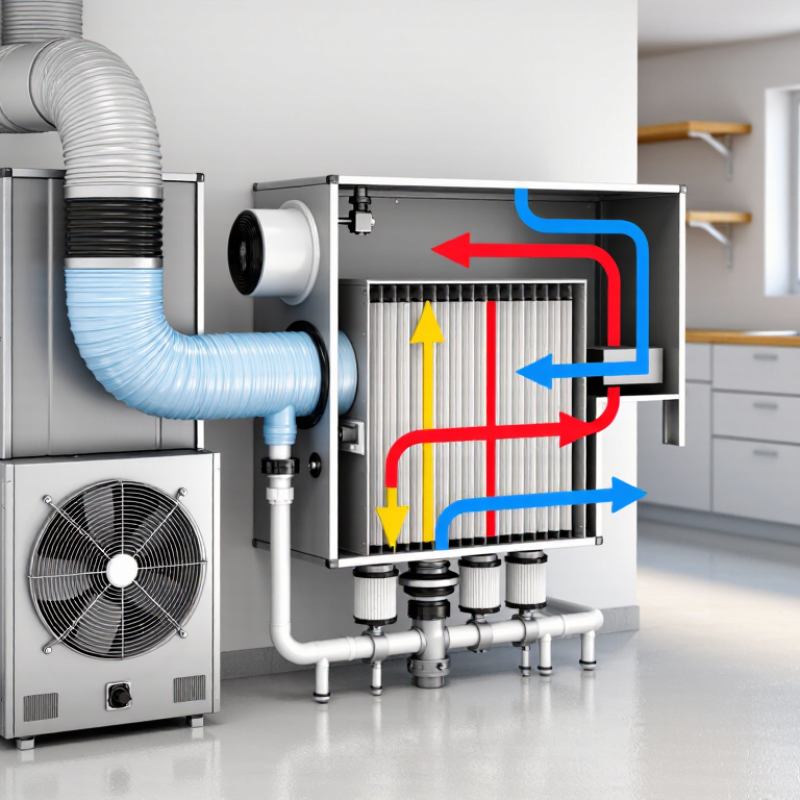
A heat recovery ventilator (HRV) exchanges stale indoor air for filtered outdoor air. Its core components work together, not separately. The air intake grille captures outdoor air before it reaches the filter. A fine filter then removes dust, pollen, and larger particles. The exhaust filter protects the internal heat-exchange core from grease and debris.
Two fans control the airflow. One fan supplies fresh air, while the other removes humid, contaminated air. The heat-exchange core keeps the air streams separate. Thin plates transfer sensible heat between them.
In winter, outgoing warm air preheats incoming cold air. In summer, the process can reduce the outdoor heat entering the building.
The U.S. Department of Energy reports that properly designed HRVs can recover up to 80% of exhaust heat. Actual performance depends on airflow balance, duct resistance, and maintenance.
Controls adjust fan speed and ventilation schedules. Pressure sensors can identify blocked filters or poor duct performance. A condensate drain removes water produced during cold-weather operation. Some systems also need a defrost cycle. It prevents frost from blocking the core.
During commissioning, technicians should measure supply and exhaust airflow, rather than trusting factory settings. ASHRAE ventilation guidance emphasizes balanced airflow and adequate outdoor-air delivery.
The neat diagram is misleading. Small installation errors can create noise, drafts, or weak ventilation. Filters need regular inspection, especially in dusty homes.
I would not treat the efficiency number as guaranteed. Real buildings are less perfect.
Heat Recovery Ventilators Compared With Standard Ventilation
A heat recovery ventilator, or HRV, replaces stale indoor air with filtered outdoor air. Unlike standard ventilation, it transfers heat between the outgoing and incoming air streams. The two airflows remain separate. A core moves heat across thin internal surfaces without mixing the air.
Standard exhaust ventilation Standard exhaust ventilation is simpler. A fan removes humid air from bathrooms and kitchens, while outdoor air enters through gaps, vents, or pressure differences. This can work in mild weather, but it may create cold drafts. In winter, heated air escapes directly. In summer, warm outdoor air can increase cooling demand. An HRV usually controls this exchange more evenly, especially in airtight homes.
The difference is noticeable near a bedroom door. With standard exhaust, replacement air may feel cold at ankle level. With an HRV, incoming air can arrive closer to room temperature. It is not magic. Performance depends on airflow balance, duct design, filter condition, and weather. A clogged filter can reduce ventilation quickly. I have also seen occupants misunderstand noise ratings; a quiet fan may still sound intrusive through poorly insulated ducts. Installation measurements matter more than brochure claims. Check supply and exhaust airflow, frost protection, and access for cleaning. An HRV may also lose value in a leaky building, where uncontrolled drafts bypass the system. This is where careful testing can challenge an attractive specification.