How to Choose an Aquarium Filter Pump for Your Tank?
Choosing an Aquarium Filter Pump is not merely a flow-rate decision. It is an ecosystem decision. Every pump moves water, but not every pump supports stable oxygen, gentle circulation, and effective waste removal. The wrong model may create noisy turbulence, stress fish, or leave dead spots behind rocks and plants. A perfect pump does not exist.
The American Pet Products Association’s 2023–2024 National Pet Owners Survey reported approximately 10.5 million United States households keeping freshwater fish. That figure shows how many homes depend on reliable aquarium equipment. Grand View Research also identifies filtration and circulation equipment as important segments within the growing global aquarium market. However, market growth does not guarantee good advice. Tank volume, stocking density, filter media, head height, and species behavior still matter more than impressive packaging.
Aquarium author Herbert R. Axelrod described the aquarium as “a world in miniature.” That idea should guide pump selection. A planted nano tank may need quiet, moderate circulation. A crowded African cichlid aquarium may require stronger mechanical filtration and higher turnover. Manufacturers often advertise maximum flow under ideal conditions. Real flow falls when tubing bends, media clogs, or water must rise vertically. Measure the actual setup, not only the box number. Experienced aquarists usually begin with the manufacturer’s recommended turnover range, then adjust after watching fish behavior and water clarity. This is where judgment becomes necessary. Clear water alone can mislead. Test ammonia, nitrite, and temperature regularly. Listen for vibration. Check whether fish struggle against the current. The best Aquarium Filter Pump is the one that quietly matches the tank’s biology, maintenance routine, and practical limitations.
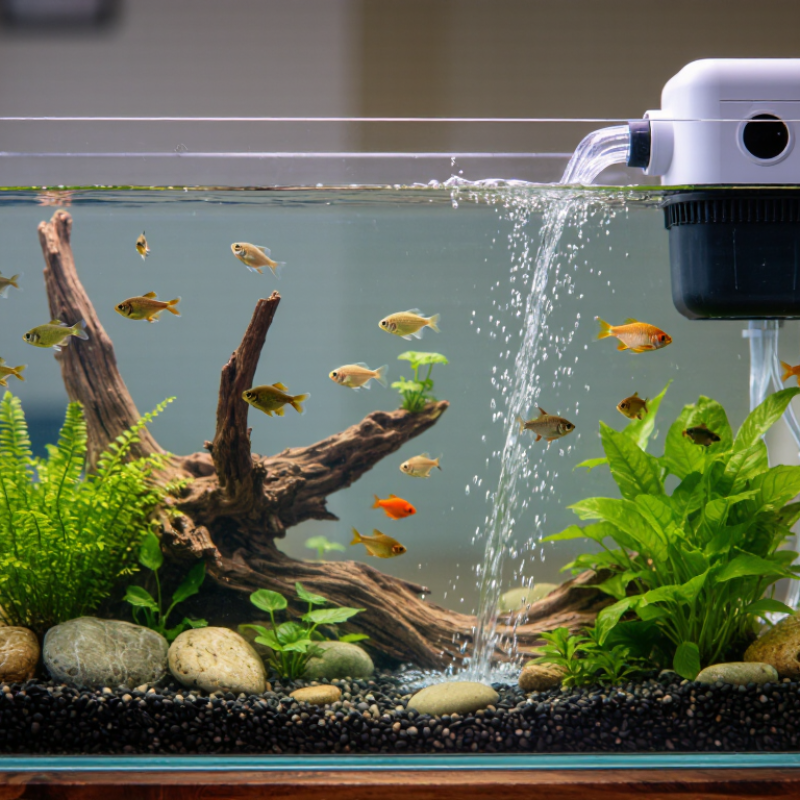
Understanding Aquarium Filter Pump Types
How to Choose an Aquarium Filter Pump for Your Tank?
Understanding filter pump types matters more than choosing the largest flow number. Internal filters suit small tanks and provide simple mechanical cleaning. Sponge filters use airlift action, making them gentle for fry, shrimp, and hospital tanks. Hang-on-back filters save interior space and offer easy media access. Canister filters hold more media, but their hoses need regular inspection. Sump systems provide the greatest media volume and equipment flexibility, though they require overflow planning.
Flow rate is not the whole story. A pump’s advertised rate usually excludes tubing, media, and lifting height. The actual flow may be much lower. The U.S. Department of Energy’s Improving Pumping System Performance sourcebook reports that pumping systems can represent 20–25% of industrial electricity use; aquarium equipment is smaller, but efficiency still affects operating costs. The Marine Aquarium Societies of North America commonly discusses moderate circulation rather than excessive turbulence. A strong pump can stress slow-swimming fish and disturb sand.
Tips: Match the pump to tank volume, livestock, and filter resistance. Check the flow at working height. Use a pre-filter sponge to protect shrimp and reduce clogging. Listen at night; rattling often signals trapped air or worn parts. A 5–10% flow adjustment may improve behavior. I sometimes choose quieter, slower filtration over maximum turnover. It is not perfect, but stable water usually matters more than impressive specifications.
Matching Pump Flow Rate to Tank Size
How to Choose an Aquarium Filter Pump for Your Tank?
Matching pump flow rate to tank size starts with turnover, not the pump’s advertised maximum. A practical aquarium guideline uses four to six tank turnovers per hour. A 200-liter tank would therefore need about 800–1,200 liters per hour before resistance. The FAO Technical Paper 581 on recirculating aquaculture systems warns that hydraulic performance depends on biomass, pipe design, biofilter media, and water quality. Tank volume alone is not enough.
Real flow is usually lower. A pump rated at 1,200 liters per hour may deliver only 700–900 liters after lifting water, bending hoses, and passing through media. Measure the outlet with a container and a timer. I once trusted the box rating too much. The tank looked clean, but debris collected behind the plants. My estimate was too confident.
Tips: Choose adjustable flow when possible. For community tanks, begin near four turnovers per hour and watch fish behavior. Strong, constant currents can exhaust slow swimmers. Heavily stocked tanks may need six to ten turnovers, but only when filtration media can handle the added flow. The 2023 Global Aquaculture Alliance guidance also emphasizes maintaining stable water quality through adequate filtration and monitoring, rather than chasing circulation alone. Check ammonia and nitrite weekly during adjustments. Clear water can still be unsafe. Recheck flow after cleaning, because clogged media quietly reduces circulation.
How to Choose an Aquarium Filter Pump for Your Tank? - Matching Pump Flow Rate to Tank Size
| Tank Capacity | Approx. Tank Volume | Freshwater Target Flow
(4–6× per hour) | Marine Target Flow
(8–12× per hour) | Suggested Rated Pump Range* | Typical Use |
| 10 gal / 38 L | 38 L | 150–230 L/h | 300–460 L/h | 250–450 L/h | Shrimp, small fish, nano aquariums |
| 20 gal / 76 L | 76 L | 300–460 L/h | 600–910 L/h | 450–900 L/h | Community fish and planted tanks |
| 30 gal / 114 L | 114 L | 460–680 L/h | 910–1,370 L/h | 700–1,300 L/h | Medium community or lightly stocked tanks |
| 40 gal / 151 L | 151 L | 600–910 L/h | 1,210–1,810 L/h | 900–1,700 L/h | General freshwater or beginner marine systems |
| 55 gal / 208 L | 208 L | 830–1,250 L/h | 1,660–2,500 L/h | 1,200–2,300 L/h | Larger community fish and mixed marine tanks |
| 75 gal / 284 L | 284 L | 1,140–1,700 L/h | 2,270–3,410 L/h | 1,600–3,100 L/h | Heavily stocked freshwater or reef systems |
| 100 gal / 379 L | 379 L | 1,520–2,270 L/h | 3,030–4,550 L/h | 2,100–4,100 L/h | Large aquariums with sump or external filtration |
How to use this table: Calculate target flow by multiplying the tank's actual water volume by the desired turnover rate. Choose a pump with a rated flow slightly above the target because tubing, filter media, elbows, lift height, and fittings reduce real-world output.
Selection tips: Use adjustable flow for delicate fish or planted tanks, check the pump's flow chart at the required lift height, and avoid excessive current that makes fish struggle or uproots plants. Marine aquariums may also require separate circulation or wave-making equipment in addition to the filtration pump.
*The suggested rated pump range is a practical starting point, not a substitute for the manufacturer's performance curve. Actual flow should be measured after the complete plumbing and filtration system is installed.
Choosing the Right Filtration Capacity
How to Choose an Aquarium Filter Pump for Your Tank?
Choosing the Right Filtration Capacity
Choosing filtration capacity begins with your tank’s actual water volume, not its advertised size. A practical starting point is four to six turnovers per hour. For a 100-liter aquarium, select a pump rated around 400 to 600 liters per hour. This rating is measured under ideal conditions. It may drop after adding hoses, media, and height.
My early mistake was choosing a pump by its maximum number alone. The flow became weak after several weeks. Dirty media and narrow tubing had reduced circulation. Check the manufacturer’s tested flow, then allow extra capacity for normal resistance. A controllable pump can help you fine-tune movement without stressing fish or plants.
Stocking also changes the calculation. Heavily fed fish produce more waste and need stronger biological filtration. However, excessive current can exhaust slow swimmers and uproot delicate plants. Watch the tank closely. Food should move gently, while debris should reach the intake. If waste settles behind decorations, circulation is probably insufficient. If fish constantly fight the current, it may be excessive. Clean mechanical media regularly, but avoid replacing all biological media at once. That small detail matters. Capacity is not only pump speed; it is stable, useful filtration over time.
Considering Energy Use, Noise, and Maintenance
Choosing an aquarium filter pump starts with matching flow to your tank, fish, and filter design. A pump rated for maximum flow may perform differently after tubing, bends, and media reduce pressure. Check the flow at the required lifting height, not only the number printed on the box. Gentle circulation suits slow swimmers, while messy fish may need stronger movement.
Energy use matters every hour. Compare wattage before buying, because a small difference becomes noticeable over a year. Choose adjustable flow when possible. It lets you reduce power during quiet periods and protect delicate plants. Noise also deserves a practical test. A low hum can disturb a bedroom, especially at night. Place the pump on a soft, stable pad, and prevent tubing from touching the glass. I once blamed the pump for rattling, but a loose cover caused most of the noise.
Tips: Clean the intake weekly. Remove trapped debris before it restricts flow. Rinse reusable media in removed aquarium water, not untreated tap water. Inspect the impeller for sand, hair, or mineral deposits. Never clean everything aggressively at once; beneficial bacteria may decline. Keep a simple maintenance note with dates, flow changes, and unusual sounds. This feels excessive at first. It can reveal problems early. Also, leave access around the pump, because a difficult cleaning routine is easy to postpone.
How to Choose an Aquarium Filter Pump for Your Tank?
Comparing energy use, operating noise, and routine maintenance across common filter pump types.
The chart uses typical planning values for freshwater aquarium equipment operating continuously for 30 days. Monthly energy use is calculated from rated power × 24 hours × 30 days. Lower wattage reduces electricity use, while lower decibel levels improve comfort in quiet rooms. Maintenance intervals are approximate and depend on stocking level, feeding, and water quality.
Installing and Testing the Filter Pump Safely
Installing and testing an aquarium filter pump safely matters as much as choosing its flow rate. The Ornamental Aquatic Trade Association recommends filtering at least four times the tank volume hourly. For a 100-liter aquarium, choose about 400 liters per hour before accounting for tubing, media, and lift height. Check the manual’s real flow data. Advertised maximum flow can be optimistic.
Place the pump securely, with its intake fully submerged. Never run a submersible pump dry. Create a drip loop before the plug reaches the socket. A residual-current device, or ground-fault circuit interrupter, adds useful protection near water. Disconnect power before touching the tank. Inspect the cable for cuts, stiffness, or exposed wiring. I once focused on flow and missed a loose intake fitting. It caused a slow leak overnight. That mistake was avoidable.
Fill the tank, open the valves, and watch the outlet for several minutes. Water should move steadily without spraying over the rim. Listen for grinding, rattling, or sudden changes in sound. Test the pump with clean water before adding fish. Mark the normal water level with removable tape. After twenty-four hours, check the cabinet, floor, and electrical connections again. The OATA guidance supports regular equipment checks, but it cannot replace careful observation. A quieter pump is not always a safer pump. A low-flow setting may also reduce biological filtration if the media receives too little oxygen.