Global solar deployment is expanding rapidly, and small sealing components now face tougher performance demands. The IEA PVPS Trends in Photovoltaic Applications 2024 report recorded more than 400 GW of new photovoltaic capacity installed worldwide in 2023. IRENA’s Renewable Capacity Statistics 2024 also reported solar as the largest source of new renewable capacity. This growth increases demand for dependable Solar Panel Gasket solutions.
A gasket may look simple beside glass, aluminum frames, and junction boxes. However, it helps resist moisture, dust, thermal cycling, ultraviolet exposure, and mechanical stress. Poor sealing can accelerate corrosion and reduce module reliability. Field experience shows that material choice matters as much as dimensional accuracy. EPDM, silicone, and specialized elastomers each offer different balances of weather resistance, compression recovery, and cost.
This article presents ten leading Solar Panel Gasket manufacturers worldwide. The evaluation considers manufacturing scale, material expertise, quality systems, customization capability, delivery consistency, and documented photovoltaic applications. Relevant benchmarks include IEC 61215 and IEC 61730, although these standards evaluate complete modules rather than every gasket independently. That distinction matters. Supplier claims should therefore be checked against test reports, traceable production records, and long-term customer evidence.
The ranking is informative, not absolute. Regional strengths, changing polymer prices, and limited public data can influence results. Some manufacturers may excel in custom profiles but lack global distribution. Others may offer scale while providing less application detail. Readers should verify current certifications, testing scope, and installation compatibility before making a purchasing decision. Small parts matter. Reliable judgment requires more than a polished catalog.
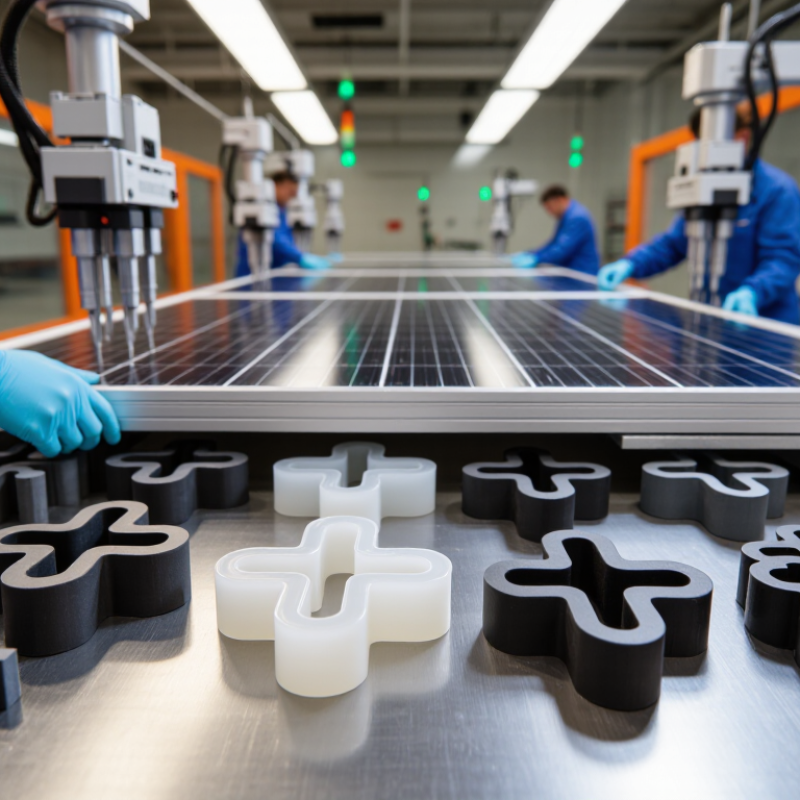
Solar panel gaskets are flexible sealing components placed between the module frame, glass, and backsheet. They close small gaps where water, dust, and air could enter. Good gaskets also absorb movement caused by daily heating and nighttime cooling. This matters because a panel may face years of rain, ultraviolet exposure, wind pressure, and repeated thermal cycling. A weak seal can allow moisture into sensitive layers, increasing corrosion risks and electrical faults.
Material selection requires practical judgment. EPDM often provides strong weather resistance, while silicone performs well across changing temperatures. However, material names alone prove little. The gasket must match the panel design, compression level, frame geometry, and installation method. During inspections, technicians should check for flattening, cracks, gaps, hardening, or uneven pressure. A gasket can look acceptable from outside and still seal poorly. That detail is easy to miss.
Tips: Measure the groove carefully before selecting a replacement gasket. Check compression without crushing the seal. Keep cut joints aligned and clean. Avoid stretching the material around corners. Review performance data for UV resistance, temperature range, water absorption, and long-term aging. Testing samples before large production runs is wise, although it may slow procurement. That delay is often cheaper than replacing damaged modules. Manufacturers with traceable quality checks, consistent dimensions, and documented testing usually offer more dependable gasket performance.
| Profile | Common Gasket Material | Typical Solar Panel Location | Key Functional Benefit | Relevant Technical Considerations | Common Testing or Reference Standards | Best-Fit Use Case |
|---|---|---|---|---|---|---|
| 1 | EPDM Rubber | Frame perimeter, junction-box sealing, cable-entry seals | Strong resistance to outdoor weathering, ozone, moisture, and ultraviolet exposure | Suitable for long-term exterior exposure; formulation and compression set must be checked for the intended temperature range | ASTM D2000 ISO 3302-1 IEC 61730 | Framed crystalline-silicon modules installed in outdoor environments |
| 2 | Silicone Rubber | Junction boxes, cable glands, perimeter interfaces, serviceable seals | Wide operating-temperature capability and good resistance to ultraviolet radiation and oxidation | Low compression set and appropriate adhesion are important; silicone is generally more permeable to gases than many organic rubbers | ASTM C920 UL 94 IEC 61730 | High-temperature locations and components requiring flexible, durable sealing |
| 3 | Thermoplastic Elastomer | Co-extruded frame seals, edge seals, snap-fit sealing profiles | Can combine elastic behavior with thermoplastic processing and efficient profile production | UV stability, creep resistance, weld-line strength, and compatibility with glass and aluminum should be validated | ISO 3302-1 UL 94 IEC 61215 | High-volume module assembly using customized extruded profiles |
| 4 | Butyl Rubber | Moisture barriers, backsheet interfaces, secondary seals | Very low gas and moisture permeability compared with many conventional elastomers | Excellent barrier performance, but surface tack, flow at elevated temperature, and long-term dimensional stability require evaluation | ASTM D2000 IEC 61215 IEC 61730 | Applications where water-vapor protection is a primary design objective |
| 5 | Neoprene Rubber | Electrical enclosures, cable-entry parts, protective interface seals | Balanced resistance to weathering, abrasion, oils, and moderate chemical exposure | Outdoor UV performance varies by compound; temperature capability and electrical insulation requirements must be verified | ASTM D2000 UL 94 IEC 61730 | General-purpose sealing where mechanical toughness and environmental resistance are required |
| 6 | Fluorosilicone | Specialized seals exposed to fuels, oils, or aggressive contaminants | Silicone-like temperature flexibility with improved resistance to hydrocarbon-based fluids | Usually selected for demanding chemical environments; higher material cost and application-specific bonding checks are common | ASTM D2000 ISO 3302-1 IEC 61730 | Specialized photovoltaic systems near industrial, transport, or chemically contaminated environments |
| 7 | Thermoplastic Polyurethane | Thin edge seals, cable protection, flexible interface components | High abrasion resistance, strong tear resistance, and good flexibility | Hydrolysis resistance, UV stabilization, and long-term creep behavior are critical for outdoor photovoltaic use | ISO 3302-1 UL 94 IEC 61215 | Compact sealing components requiring toughness and precise molded or extruded geometry |
| 8 | Fluoroelastomer | Specialized high-performance seals and harsh-environment interfaces | High resistance to heat, chemicals, and many aggressive fluids | Higher hardness, cost, and compression-force requirements may affect design; low-temperature flexibility must be checked | ASTM D2000 ISO 3302-1 IEC 61730 | Specialty photovoltaic equipment exposed to high heat or aggressive chemicals |
| 9 | Closed-Cell Silicone Foam | Compression seals between dissimilar surfaces and enclosure covers | Lightweight cushioning with a degree of moisture resistance and tolerance for surface irregularities | Cell structure, density, compression-deflection behavior, and recovery after prolonged compression must be controlled | ASTM D1056 UL 94 IEC 61730 | Sealing assemblies that require gap compensation and low assembly force |
| 10 | Polyolefin-Based Sealant | Backsheet edges, encapsulant interfaces, and integrated sealing layers | Low moisture absorption and compatibility with several polymer-based module materials | Adhesion, thermal expansion, water-vapor transmission, and compatibility with encapsulants must be tested as a complete system | IEC 61215 IEC 61730 ISO 4892-3 | Glass-glass and polymer-interface designs requiring integrated moisture management |
Solar panel gaskets help prevent water ingress, dust contamination, electrical insulation failure, corrosion, and mechanical damage. Actual material selection should be confirmed through complete-module validation, including damp-heat, thermal-cycling, humidity-freeze, ultraviolet, insulation, and ingress-protection testing. Standards and test methods should be applied according to the module design and the target market.