Why Choose a Durable Trampoline Mat for Your Business?
For a trampoline park, the mat is more than a jumping surface. It must handle repeated landings, daily cleaning, and constant tension across its seams and anchor points. When performance changes, staff may face repairs, downtime, and questions from customers. A durable Trampoline Mat can support reliable operations, but durability should be demonstrated—not assumed.
The U.S. Consumer Product Safety Commission’s National Electronic Injury Surveillance System estimated 104,691 trampoline-related emergency department visits in 2014. This is a historical estimate, not a current annual count. It also does not identify commercial parks or mat failures specifically. Still, it is a useful reminder that equipment condition deserves careful attention. ASTM International’s F2970 standard addresses design, installation, operation, maintenance, and inspection for trampoline courts. A mat choice should fit within that broader safety process.
For business buyers, compare documented material specifications, seam construction, edge attachment, and supplier test results. Ask how the mat is expected to perform under frequent use, and what inspection or replacement guidance comes with it. Get the details in writing. A thick surface alone proves little. Even a well-made mat can wear prematurely if it is poorly installed, overloaded, or not inspected. That part is easy to overlook. The right purchase balances service life, consistent bounce, maintenance needs, and clear supplier support. It may not be the cheapest option today, but a realistic total-cost comparison can reveal its value over time.
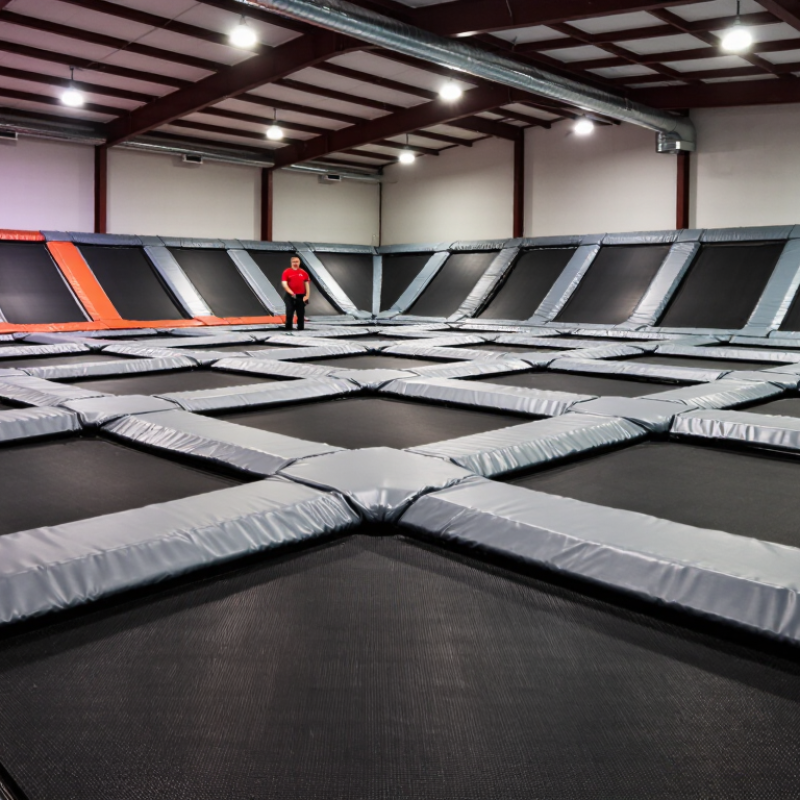
Commercial Trampoline Mats: Business Uses, Users, and Safety Risks
Commercial trampoline mats support a range of business activities. Fitness studios use them for supervised rebound workouts, while camps and family activity centers offer recreational jumping. Each setting brings different users, from young children to adults, and different levels of daily wear. A mat should match the equipment’s specifications and expected use, not just look sturdy. Appearance can mislead.
Durable materials and secure stitching may help a mat withstand repeated use, but they do not remove the need for checks. Staff can inspect seams, attachment points, and the jumping surface before opening. Look for fraying, stretched areas, or damage after heavy sessions. Do it daily. Coaches also need clear rules, suitable supervision, and controlled participant numbers. A strong mat cannot prevent every collision or poor landing.
Wear can develop gradually, especially in busy venues or equipment exposed to sunlight and moisture. Replace a mat when its condition falls outside the equipment maker’s guidance, and keep maintenance records. The surrounding frame, springs, padding, and access area need attention too. One weak component can affect the whole setup. Safety routines may feel repetitive, and staff can miss things on a rushed day; that is a reason to use a simple checklist, not a reason to skip it.
Why Choose a Durable Trampoline Mat for Your Business?
Commercial Trampoline Mats: Business Uses, Users, and Safety Risks
A U.S. pediatric safety estimate reports that about 75% of trampoline injuries occur when more than one person is jumping at a time. For trampoline businesses, a durable, well-maintained mat should be part of a broader safety plan that includes clear one-jumper-at-a-time rules and active supervision. This figure describes reported injuries, not commercial-facility incidents, and does not measure the effect of mat durability.
Source: American Academy of Pediatrics, “Trampoline Safety in Childhood and Adolescence,” Pediatrics, 2012; 130(4):774–779.
Mat Materials and Stitching: Key Factors in Load Resistance and Wear
For a business trampoline, the mat must handle repeated loading, not just look sturdy on delivery. Woven polypropylene is common because it balances strength and flexibility, but its performance depends on yarn quality, weave density, and UV protection. Outdoor mats face sun, moisture, and grit; indoor mats may see more frequent use in one concentrated area. Match the material specification to the setting and the supplier’s stated load limits. A thicker mat is not automatically stronger. Not always. Dense, even weaving and secure edge construction matter too.
Inspect the stitching closely. Multiple, consistent rows help spread tension around the mat’s perimeter, while reinforced webbing can reduce strain where springs connect. Look for neat seams without skipped stitches, loose thread, or puckering; these can signal uneven tension or poor finishing.
Small details matter. Stitch count alone does not prove durability, since thread strength, seam placement, and workmanship also affect wear. Ask how the mat is tested and what inspection schedule is recommended. Check connection points for fraying and seams for opening, especially after heavy use. Even a well-made mat wears eventually, and judging it by appearance alone can miss early damage.
ASTM F2970: The U.S. Standard for Commercial Trampoline-Court Operations
Why Choose a Durable Trampoline Mat for Your Business?
ASTM F2970 is a U.S. consensus standard practice for commercial trampoline courts. It addresses design, installation, operation, maintenance, inspection, and major modifications. It is not a substitute for local requirements, staff training, or sound daily judgment. For operators, that distinction matters. A mat is not merely a jumping surface; its seams, attachment points, and tension affect how the court performs under repeated use.
A 2012 Pediatrics analysis of U.S. emergency-department records estimated about one million trampoline-related injuries between 2002 and 2011. The estimate covers trampoline injuries broadly, not commercial courts alone. Still, it underlines why regular inspection deserves attention. Look closely for frayed stitching, loose fasteners, thinning areas, and edges that no longer sit evenly. Small defects matter. A mat may look acceptable from across the court and still need a closer check.
ASTM F2970 supports a documented approach to inspection and maintenance, helping teams identify wear before it becomes harder to manage. Record findings, note repairs, and follow the mat maker’s care instructions. Staff should also know when to restrict access and request a qualified assessment. No checklist catches everything. That’s worth remembering, especially during busy periods, when a quick visual glance can feel like enough.
Inspection Records: Tracking Mat Wear, Damage, and Maintenance
A durable trampoline mat can still wear unevenly, especially near springs, seams, and busy landing zones. A simple inspection log helps staff spot changes before they become difficult to assess. Record the date, inspector, mat location, and condition under consistent lighting. Look for frayed stitching, stretched fabric, fading, loose attachments, and grit trapped along the edge. Take a close photo beside a ruler when a tear or thinning patch appears. Small marks matter.
Note cleaning, repairs, and any periods when the mat was removed from use. Use plain descriptions rather than vague entries such as “checked” or “fine.” For example: “South landing zone; two loose stitches; recheck Friday.” Set a review date and assign someone to verify completed repairs. If damage grows or the surface feels unusually slack, keep the mat out of use until a qualified technician assesses it. Logs are not perfect. Busy shifts can leave gaps, and staff may judge wear differently. A shared checklist and brief photo record make changes easier to compare and discuss. Keep records accessible, and update them immediately after each inspection.
Why Choose a Durable Trampoline Mat for Your Business? - Inspection Records: Tracking Mat Wear, Damage, and Maintenance
Illustrative inspection log: The anonymized entries below demonstrate practical tracking fields and realistic findings; they are not verified records from a specific facility. Follow the mat manufacturer’s instructions and applicable safety requirements when setting inspection and replacement criteria.
| Inspection Date | Mat ID | Use Since Last Check | Wear / Damage Observed | Condition | Maintenance or Safety Action | Next Check |
| 2026-08-04 | MAT-014 | Approx. 42 operating hours | Even surface wear; stitching and edge attachment intact; no visible holes. | Serviceable | Cleaned and recorded as a routine inspection; equipment returned to use. | Routine daily check; detailed inspection in 30 days |
| 2026-08-11 | MAT-027 | Approx. 36 operating hours | Small abrasion near the outer edge; no opening through the mat and no loose stitching observed. | Monitor | Photographed and logged the abrasion; checked surrounding attachment points and increased observation during daily checks. | Within 7 days, or sooner if damage changes |
| 2026-08-18 | MAT-009 | Approx. 51 operating hours | Two adjacent stitches loose at an edge seam; surrounding fabric appears intact. | Restricted pending repair | Removed from service and tagged; repair to be assessed and completed in accordance with manufacturer instructions before reuse. | Before return to service |
| 2026-08-25 | MAT-031 | Approx. 29 operating hours | Surface and seams intact; light debris found around the mat perimeter. | Serviceable after cleaning | Removed debris, checked the mat and attachments, and documented the inspection. | Routine daily check; detailed inspection in 30 days |
| 2026-09-02 | MAT-018 | Approx. 47 operating hours | Small through-hole found in the jumping surface; nearby stitching shows fraying. | Remove from service | Closed access to the equipment and tagged the mat. Arrange replacement or an approved repair assessment; do not use until cleared. | Before any return to service |
| 2026-09-09 | MAT-022 | Approx. 33 operating hours | One attachment point appears loose; no visible tear in the mat fabric. | Remove from service pending check | Stopped use and inspected the attachment system; maintenance staff to verify the connection and mat condition before reopening. | Before any return to service |
| 2026-09-16 | MAT-014 | Approx. 39 operating hours | No new damage; previously recorded edge area remains stable and stitching is intact. | Serviceable | Compared with the prior inspection entry and photo; continued routine checks. | Routine daily check; detailed inspection in 30 days |